
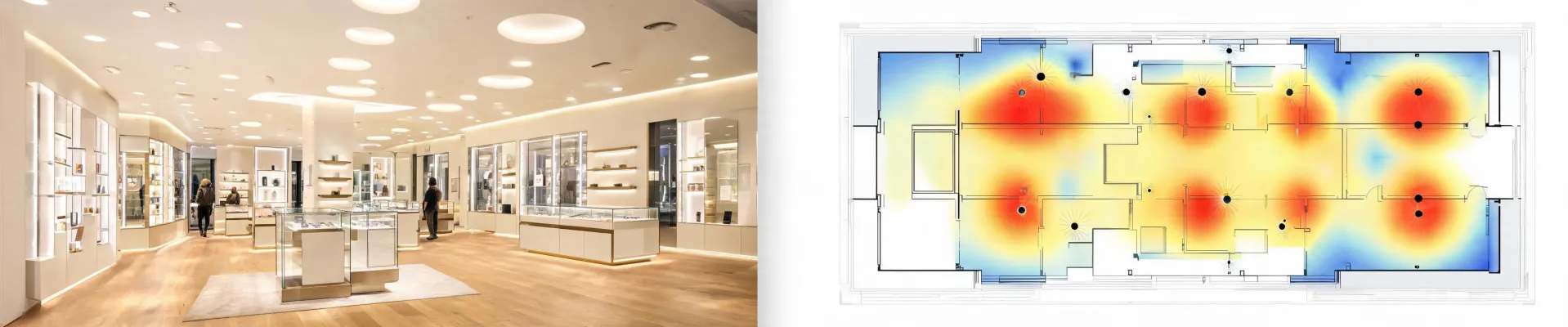
Full disclosure: I'm a quality and compliance manager at Opple, an LED commercial lighting manufacturer. I review every fixture line before it reaches distributors and wholesalers—roughly 200+ unique products a year. In January 2024, I rejected a batch of 2,500 ceiling light panels that looked perfectly fine in photos. The color temperature mismatch between units was obvious once you placed them side by side. We sent the whole batch back.
That rejection started a conversation that changed how I think about my job. Ceiling light specifications aren't just engineering details. They're a brand promise. If you're a light fixture distributor, that promise is yours, not the manufacturer's, by the time the fixture reaches your customer.
Most distributors don't wake up thinking about quality. They wake up thinking about margin, delivery dates, and whether they've got the right SKUs. I get that. But I've watched too many projects go sideways because someone treated the spec sheet as a formality instead of a promise.
Consistency Is the Specification Nobody Talks About
Here's a question I ask distributors who visit us: 'Have you ever received two batches from the same supplier that felt completely different?' Most of them nod. Same SKU, same datasheet, different experience. That's what happens when quality is treated as a one-time sample approval instead of a production process.
Consistency doesn't show up on a beautiful spec sheet. It shows up in tolerances that the manufacturer often doesn't mention. For ceiling lights, that means CCT tolerance, driver reliability, and whether the LED bin in production matches the LED bin you approved. A typical datasheet might not list CCT tolerance at all, or it might say ±150K. In a commercial space with rows of 4000K panels, that's enough to create visible stripes of cooler and warmer light.
One client of ours ordered ceiling lights from a marketplace listing that checked every box on paper. By the third month, some drivers started humming in quiet office areas. Not a failure—just a hum. But in a conference room, that hum was all anyone heard. They replaced the entire lot. The conversation started as a warranty issue and ended as a trust issue.
Before you approve a ceiling light spec, ask about the LED package and the driver. Look for IES LM-80 data for the LED package, and verify that the driver has a real thermal rating. If a supplier can't explain the difference between LM-80 and L70, treat that as a red flag. Those details define how 'premium' the actual experience feels.
Compliance Requirements Are a Brand Filter
Let's talk about light fixture compliance requirements, because this is the part that can quietly destroy a project.
North American buyers face a more rigorous compliance environment than they did a decade ago. UL 1598 covers the safety of luminaires. DLC listing—the DesignLights Consortium—is practically a baseline for commercial LED projects that want utility rebates. California's Title 24, Part 6 has its own efficiency rules. As of 2025, these are not optional extras for a commercial product line.
I've seen spec sheets that say 'UL Listed' on page one, but the file number didn't exist on the certifier's database. I've seen distributor listings marked 'DLC' when the product was never registered. Sometimes it's not intentional fraud; it's just a marketing team that reused an old brochure. But the result is the same: a compliance issue shows up during an inspection, and the distributor is left to explain it.
That's why I argue that compliance isn't just a legal checklist. It's part of the customer experience. A rejected rebate, a delayed inspection, a certificate that can't be verified—these cost your client time and money. And they'll remember who sold them that fixture.
We invest in spec and compliance expertise at Opple for a simple reason: our customers don't have time to verify every file. When a supplier makes compliance easy, it strengthens the distributor's own brand with electricians, contractors, and building owners.
Price Is Data. Quality Is Memory.
The conventional wisdom is to let the numbers decide. On paper, the budget fixture often looks almost as good as the premium one. I've been in that situation more times than I can count, and I've made the wrong call at least once.
A few years ago, I compared two LED downlight options side by side. The cheaper one was about 12% lower in price, and its photometric report was within a few points of the more expensive option. Every cost analysis pointed to the budget fixture. My gut said something was off. The sample looked dull in the finish, and the driver spec wasn't clearly documented. But I signed off anyway.
The failure wasn't dramatic. No smoke. No overnight flicker. The issues appeared slowly over eight months: a driver hum, a bezel that discolored, one downlight that quit in a stairwell. Nothing that would trigger a recall. Everything that would damage a reputation.
Here's the thing: the cost difference between those fixtures was about $2.40 per unit. On 8,000 units, that's $19,200. The rework, the truck rolls, and the client hesitation cost us far more than that. The hidden math of commercial lighting is that the unit price is easy to calculate. The cost of a damaged relationship isn't.
I'm not saying budget fixtures are always bad. I'm saying they're a risk you should price explicitly. When you buy a cheap ceiling light for a client, the real cost is the probability that the room looks right and performs reliably for years.
'But My Customers Only Care About Price'
If you sell to people who never come back, maybe. But in commercial lighting, almost every buyer has a next project.
Here's the thing: quality doesn't mean the most expensive fixture. It means the fixture you can stand behind without writing a three-paragraph explanation later. A basic commercial-grade ceiling light with honest specs and a verified UL file is better for your brand than a 'premium' fixture with no compliance trail.
Another objection: 'If something fails, I'll just replace it under warranty.' But in commercial lighting, the replacement cost is rarely the full cost. The electrician's labor, the downtime, the owner's annoyance, the scheduling hassle—that's real money. And it comes out of your reputation, not just your pocket.
Quality Is a Brand Promise, Not a Cost Center
When I started this job, I thought my job was to catch defects. Four years later, I understand it's bigger than that. I'm here to make sure every fixture that leaves our facility is something a distributor can confidently put their own name behind. Because once it's on a truck, it's not just an Opple product. It's the distributor's promise.
When you choose an Opple ceiling light—or any other well-documented fixture, for that matter—you're not just buying a SKU. You're buying certainty. You're buying a version of 'good' that you can defend to an inspector, a client, and your own team.
Ask yourself what your last 100 delivered ceiling lights said about your company. If you're not sure, that's the risk. In this industry, the difference between a strong reputation and a damaged one is often a few hundred Kelvin of color temperature tolerance, one missing compliance file, or a hum that nobody wants to explain.
Quality is your brand. I'd rather reject a batch today than apologize to a customer next year.

Clara Whitmore
Clara Whitmore is a lighting photometry and LED source analyst specializing in bulbs, tubes, strips, panels, and integrated luminaires. She interprets IES LM-79 measurements and TM-30 color rendition data through luminous flux, efficacy, intensity distribution, CCT, chromaticity, fidelity, and gamut metrics. She writes evidence-led comparisons for specifiers selecting source formats and luminaires for commercial interiors, industrial spaces, or horticultural systems where measured optical and color performance matter.