
-
Who this checklist is for
-
Step 1: Map the room before you talk to anyone
-
Step 2: Ask for the spec sheet and the test report
-
Step 3: Buy samples and actually look at them
-
Step 4: Verify invoicing and payment terms before the first PO
-
Step 5: Lock lead time and partial shipment terms in writing
-
Step 6: Read warranty terms line by line
-
Common mistakes I've made (so you don't have to)
-
The bottom line
Who this checklist is for
If you're the one placing orders for your company's office, retail space, or warehouse lighting—not a lighting designer, just the person who gets the requisition form—this is for you. I'm the office administrator for a 400-person company with three locations. I manage roughly $150,000 a year in facilities and MRO purchasing across 8 vendors. Lighting is a small slice of that, but it's the one that causes the most trouble, because you don't know you've bought the wrong thing until it's on your ceiling.
Here's the 6-step checklist I run every time I evaluate a commercial lighting supplier. It's not theoretical—it's the version I built after enough mistakes to stop winging it.
Step 1: Map the room before you talk to anyone
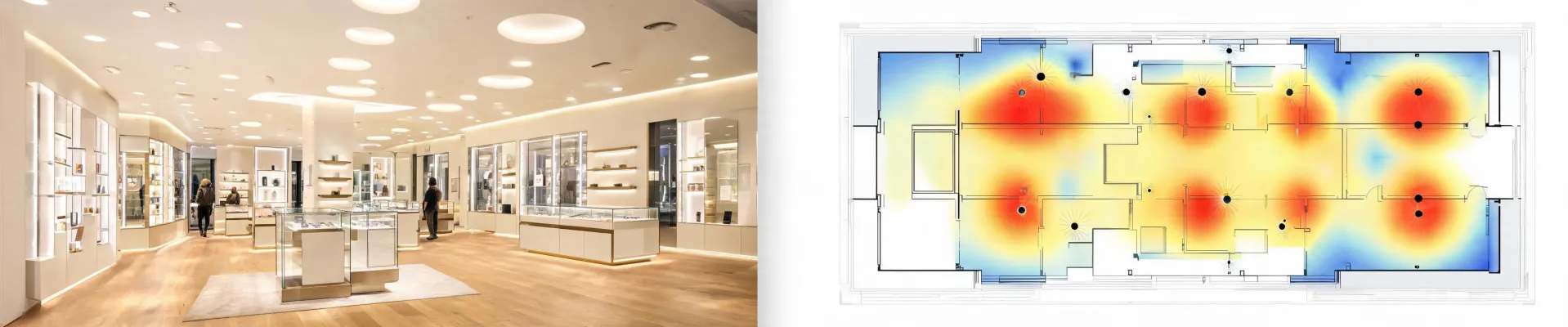
Before you email a single distributor, write down what you actually need—room by room. Not "20 ceiling lights." More like "20 2x2 panels, 4000K, 3500+ lumens, 0-10V dimming."
This sounds obvious. It isn't. Most people I know skip this step and end up comparing quotes that aren't comparable.
What to write down:
- Lumens, not watts. In 2025, watt-for-watt comparisons between LED fixtures can swing 40% in output. Compare lm/W, not W.
- Color temperature (CCT). 3000K is warm, 4000K is neutral, 5000K is cool. Mixing these across one floor looks amateur.
- CRI. 80+ for general areas. 90+ if it's retail or design-related.
- Dimming protocol. 0-10V, DALI, and TRIAC aren't interchangeable. Ask this early—suppliers who can't answer it, don't get a second email.
My worst version of this: a 2023 office refresh where we ordered 80 panels, all 5000K, because that's what the previous vendor delivered. Turned out the designer had spec'd 3500K for the whole build. We replaced every fixture at our own cost. Ceiling damage alone was $2,100.
Step 2: Ask for the spec sheet and the test report
This is the first hard filter. A real commercial lighting supplier—Opple, any reputable brand—should hand you an LM-79 or LM-80 test report alongside the spec sheet. If a quote only says "equivalent to 40W" with no document, move on.
What to actually check:
- Lumen output on the report vs. what's on the spec sheet. Mismatches happen. More than you'd think.
- CRI value measured, not claimed. If a spec says 90 and the report says 82, that's your answer.
- SDCM (color consistency). Under 5 is acceptable. Under 3 is good. If you're putting 20 fixtures on one ceiling, you'll see the difference visually.
- Dimming compatibility list—which drivers/controls were tested. If they can't name any, ask them to test. If they won't, that's a red flag.
Suppliers who are serious about commercial work usually appreciate this step. They send the PDFs without being asked twice. Suppliers who aren't, start getting vague.
Step 3: Buy samples and actually look at them
I don't skip this anymore. One or two units, installed, running for a few hours. Then I walk past them at night when nobody's around and see if I still like them.
What happened when I did skip it: back in 2022, we trialed a new supplier who was 30% under our existing vendor. Samples looked fine in a quick look. We placed a full order for a 120-fixture warehouse retrofit. After install, about a third had visible flicker. Driver issue, batch-wide. The supplier offered a warranty swap process that took 6 weeks per round. We ate the cost and went back to our original vendor. Net loss on that project: somewhere around $14,000 between labor, correction, and the original spend.
Sample test now includes:
- Actually install it. Not just powered on a desk.
- Run it for 4+ hours and look for flicker or color shift.
- Check physical build (weight, finish, driver quality under the cover).
- Confirm the sample came from production stock, not a hand-built demo unit.
Step 4: Verify invoicing and payment terms before the first PO
This is the step most people skip, and it's the one that made me look bad to my finance team.
In 2021, I found a great price on Opple ceiling lights from a new distributor—$320 cheaper than our regular source on a 60-unit order. Ordered on a Friday. Everything shipped on time. Product was fine.
Then finance rejected the invoice. The vendor could only provide handwritten receipts. No tax invoice, no PO match, nothing finance could reconcile. I'd already paid out of the department budget. That $320 savings turned into a $4,200 hole I had to explain in a monthly review.
Now I run a small test PO with any new vendor before committing to real volume:
- Can they produce a proper tax invoice matching our PO number?
- Do their payment terms align with our 30-day net cycle?
- Who's the billing contact when something's wrong? Not the sales rep—the actual billing contact.
If invoicing breaks, price doesn't matter.
Step 5: Lock lead time and partial shipment terms in writing
Quoted lead times are usually "estimates," not commitments. There's a difference, and you'll feel it at the wrong moment.
What I ask for now, every time:
- Lead time in weeks, not days—production plus freight
- Partial shipment option if the order exceeds 300 units
- Penalty clause for late delivery, even a token one—it changes supplier behavior
- Packaging spec in writing (individual boxed vs. bulk-carton)
Packaging is where communication dies quietly. I once said "individually packed" and meant each fixture in its own carton. The supplier heard "individually boxed in one outer carton." When the order arrived, 120 panels were stacked together in a single pallet box. Installation crew spent two days just unpacking and sorting. Same words, different meanings.
Step 6: Read warranty terms line by line
"5-year warranty" sounds clean. It rarely is.
What to check:
- What's covered? Just the fixture, or the driver too? Drivers are usually where failures happen—often 60%+ of field issues.
- Who pays for installation on a warranty swap? If a fixture fails in year 3, is the labor on you? On them?
- Warranty clock starts when? Production date or installation date. That's often a 3-4 month gap.
- Claim process. Photo evidence? Ship the failed unit back first? Advance replacement? Advance replacement saves you weeks for a ceiling fixture. Getting a replacement for a ceiling fixture is not like getting a replacement for a light bulb.
I'd rather work with a supplier whose warranty is written in plain English than one with a 12-page legal document. Generally, the suppliers who write clearly also behave clearly.
Common mistakes I've made (so you don't have to)
Five that come to mind, in order of what they cost me:
- Comparing price per unit only. Total landed cost includes freight, duty, rush fees, and spare stock. The cheapest quote on paper is usually not the cheapest in reality.
- Not specifying dimming compatibility in the RFQ. You end up with a floor full of buzzing fixtures you can't return.
- Using one supplier for everything. I have mixed feelings about this. Consolidation is easier to manage, but during the 2023 supply crunch, having a second vendor literally saved one of our projects. I compromise with a primary plus a vetted backup.
- Trusting "in stock" without a number. Ask for a live quantity and a timestamp. "We checked this morning, it's 850 units" is fine. "It's in stock" is not.
- Forgetting spare inventory. Order 5-10% extras on anything you can't easily re-source. By the time you need a matching batch, the color may have drifted and the SKU may be discontinued.
The bottom line
Evaluating a commercial lighting supplier isn't about the product catalog. It's about documents, timing, invoice process, and warranty clarity. Those four things decide whether your project goes smoothly or becomes a two-month detour.
Opple ceiling lights and commercial LED ranges have worked well for us—their spec documentation is thorough, LM-79 reports are available for most of the line, and their regional distributors generally understand how to work with a procurement process. But the checklist works with any legitimate vendor. The suppliers who show up with documentation, answer the sample-stage questions without dodging, and can explain their warranty in one paragraph—those are the ones worth keeping.
Six steps. Runs about two extra days upfront. One avoided re-install pays for it many times over.

Victor Mensah
Victor Mensah is an industrial lighting analyst specializing in high-bay, warehouse, hazardous-location, emergency, and exit-lighting systems. He separates IEC 60598-2-22 emergency-luminaire checks from IEC 60079-0 hazardous-equipment requirements while examining ambient temperature, ingress protection, mounting height, emergency duration, egress visibility, gas or dust classification, and maintenance access. He writes selection guides for plant teams comparing light output, environmental suitability, safety evidence, installation complexity, and lifecycle risk without treating wattage or one enclosure rating as complete proof.