
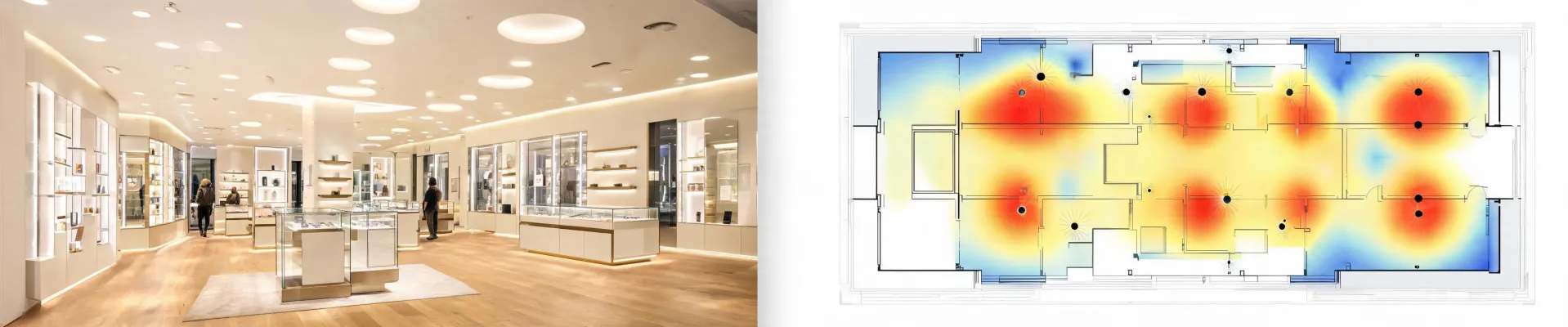
The 3 a.m. email: “We need 400 downlights by Friday”
A contractor emailed me at 3:12 a.m. last March. Subject line: URGENT — 400 recessed downlights, site needs Friday. The electrician had already installed the rough-in. The ceiling grid was up. The general contractor had promised the owner the space would be lit for a Monday walkthrough. Normal lead time for that fixture was 3–4 weeks. They had four days.
When I called back, the first question was predictable: “Can you expedite shipping?” That is almost always the first question. And it is almost never the real problem.
I have handled rush orders for commercial lighting projects for about six years now. I have learned that when a deadline is tight, most buyers think they are shopping for speed. They call distributors, ask who has stock, compare air freight quotes, and try to squeeze the last 24 hours out of transit. For downlight wholesale, that feels logical. A downlight is a box. If the box is in a warehouse, you put it on a truck.
But commercial LED lighting is not just a box. It is a listed assembly, a driver, a trim, a color temperature, a beam angle, a dimming protocol, and a stack of compliance paperwork. The rush order does not fail because the truck is slow. It fails because the exact configuration you need is not the configuration that is actually available and legally installable.
What most buyers think the problem is: lead time
If you are sourcing Opple ceiling light products or Opple commercial lighting for a project, lead time is the visible pain. You see the calendar. You see the site schedule. You see the penalty clause. So you focus on speed.
That leads to three common moves:
- Call every distributor within 500 miles and ask for stock.
- Offer to pay for expedited freight.
- Accept a substitute SKU that looks close on the spec sheet.
Honestly, I have made that third mistake myself. In 2022, I approved a substitute for a hotel corridor project because the wattage and size matched. The original was 3000K, 90 CRI, 0–10V dimming. The substitute was 4000K, 80 CRI, TRIAC dimming. The client’s lighting designer caught it during a pre-installation walk. We ended up air-freighting the correct units anyway, and the project still slipped two days. The savings from the substitute were gone before lunch.
So the surface problem looks like this: the product is not moving fast enough. The deeper problem is that the product was never the right product for that project’s compliance and design requirements.
The deeper problem: compliance and variant mismatch
Here is the part that does not show up in a freight quote. For commercial fixtures, the exact model number has to match the listing and the project requirements. That is especially true for spotlight compliance requirements and recessed lighting, where inspectors look at the fixture, the driver, the junction box, and the paperwork.
Per UL 1598 and UL 8750, luminaires and LED drivers need to be listed for the intended application. UL does not “approve” products in the casual sense. It lists them. If you change the driver, the CCT, the dimming protocol, or the wet-location rating, you may move outside the scope of the existing listing. The fixture may still light up on a bench. It may still look fine in a photo. But it may not pass inspection.
That is the bottleneck nobody plans for. The factory might have 400 downlights in stock. But if your project needs 3500K, 90 CRI, 0–10V dimming, wet location, and a specific trim, those 400 units may not be the same product. Swapping a trim is easy. Swapping a driver and proving the new combination is covered by a test report is not.
I wish I had tracked how often this happens across all our rush requests. I don’t have hard data on industry-wide failure rates. But based on our 5 years of order history, my sense is that 30–40% of rush requests fail the first pass because of a compliance or variant mismatch, not because of freight. We have processed maybe 200 rush orders—no, closer to 280, I’d have to check the system. The pattern is clear.
The same issue applies to recessed lighting manufacturer selection. A factory can be fast at assembling standard SKUs. But if you need OEM/private label, a custom CCT, or a different beam angle, the timeline is not just production. It is documentation, testing, and listing verification. LM-79 and LM-80 test reports, TM-21 lumen maintenance projections, IP ratings, DLC listings, ENERGY STAR requirements—these are not decorative PDFs. They are the reason a substitute can be sitting in a warehouse and still be unusable for your job.
The rush order is rarely a shipping problem. It is a documentation problem that shows up as a shipping problem.
This was accurate as of Q4 2024. Certification schemes and DLC technical requirements change periodically, so verify current listings and versions with UL Solutions, DLC, ENERGY STAR, or your local authority having jurisdiction before you commit.
What that mismatch actually costs
When a rush order goes wrong, the visible cost is the expedited freight. The real cost is everything around it.
In March 2024, a client called 36 hours before a deadline needing 300 downlights for a retail rollout. The spec called for 3000K, 0–10V dimming, and wet-location rating for an exterior soffit. Our standard stock was 4000K, dry location. We found a vendor with the correct listed assembly, paid $1,800 extra in rush fees on top of the $9,400 base cost, and delivered with about four hours to spare. The client’s alternative was delaying a $12,000 installation package and triggering a $3,500 penalty clause. The upside of using a cheaper substitute was maybe $2,000. The risk was missing the deadline and forcing the electrician to remobilize. I kept asking myself: is $2,000 worth potentially losing the account?
That math almost never works. Missing a deadline in commercial lighting does not just delay a fixture. It delays the electrician, the ceiling crew, the inspector, and the owner’s opening date. It can push a certificate of occupancy. It can turn a small spec error into a visible defect.
And this is where quality perception comes in. When a client walks into a finished space, they do not see your spec sheet. They see the light. If one row of Opple ceiling light fixtures is 4000K and the rest are 3000K, the ceiling looks patchy. If the dimming flickers at low end, people notice. If the beam angle is wrong, the wall wash looks uneven. Those details read as “this company cut corners” even if the paperwork was technically fine.
There is something satisfying about a perfectly executed rush order. After all the stress and coordination, seeing it delivered on time and correct—that is the payoff. But the best rush orders are the ones you do not need. The best ones are planned with enough buffer that a variant mismatch never becomes a 3 a.m. problem.
How to avoid the rush-order trap
So what actually works? Not a secret freight lane. Not a magic warehouse. It is boring, unglamorous preparation.
First, lock compliance before you lock price. Ask for the UL or ETL file number, the DLC listing, the LM-79 and LM-80 reports, the driver specification, the IP rating, and the exact model number for the configuration you need. For spotlight compliance requirements, confirm the listing covers the application: wet location, insulated ceiling, dimming protocol, voltage, and ambient temperature.
Second, use a recessed lighting manufacturer that can document variants instead of just quoting stock. At Opple, when we quote Opple commercial lighting, we try to flag substitutions that would require a new report or a different listing. That is not a sales pitch. It is the difference between a fast order and a fast order that passes inspection.
Third, build in a 48-hour buffer for any project with a hard deadline. I learned that in 2023 after we lost a $28,000 contract because we tried to save $600 on standard freight instead of expedited. The shipment arrived one day late. The client had already rented lifts and scheduled the electricians. That one day cost us the relationship. Now our internal policy requires a 48-hour buffer on any commercial lighting order with a fixed install date.
Fourth, for downlight wholesale orders, confirm the exact CCT, CRI, beam angle, trim finish, voltage, and dimming protocol. Do not assume “3000K” means the same thing across factories. Do not assume a driver is compatible just because the wattage matches. Do not assume a fixture is wet-location rated because the housing looks sealed.
Bottom line: if you are sourcing Opple ceiling light or any commercial LED fixture on a tight timeline, the fastest path is usually the one with the cleanest documentation. Speed matters. But in commercial lighting, compliance is speed. A listed, verified, correctly specified fixture can move. A cheap substitute that fails inspection cannot.
That said, this is based on my experience with commercial projects and rush orders. Your authority having jurisdiction, project spec, and local code may add requirements I have not covered here. Verify the current standards before you buy.

Clara Whitmore
Clara Whitmore is a lighting photometry and LED source analyst specializing in bulbs, tubes, strips, panels, and integrated luminaires. She interprets IES LM-79 measurements and TM-30 color rendition data through luminous flux, efficacy, intensity distribution, CCT, chromaticity, fidelity, and gamut metrics. She writes evidence-led comparisons for specifiers selecting source formats and luminaires for commercial interiors, industrial spaces, or horticultural systems where measured optical and color performance matter.