
The delivery that started it all
Last March, I stood in our warehouse staring at 800 downlights that were supposed to be 4000K. They looked fine in the boxes. The labels said 4000K. The spec sheet—the one I'd personally approved against Opple's commercial lighting catalog—said 4000K. But when our technician ran the color temperature meter across the batch, we were getting readings between 4150K and 4350K on nearly every unit. That's a visible difference on a commercial ceiling. On a retail floor, it's the kind of subtle inconsistency that makes you look like you don't know what you're doing.
This wasn't a cheap supplier. It was a reputable OEM factory we'd been working with for two years. And honestly, I should've caught it earlier.
What I got wrong about downlight sourcing
When I first took over vendor quality management in 2022, I thought the OEM vs private label decision was mostly about branding and cost. OEM gave us the factory's existing designs with our logo. Private label meant custom tooling. Simple enough, right?
Three rejected batches later, I learned that the real difference isn't branding—it's who owns the quality standard.
With pure OEM, the factory decides what tolerances are 'acceptable.' You're renting their production line, but you're also inheriting their shortcuts. And most factories, in my experience, will let things slide within what they consider 'industry standard.' The problem is, 'industry standard' for a residential bulb is not the same as 'industry standard' for a downlight catalog going into a hotel lobby.
With private label, you control the spec. But you also take on the cost and risk of proving those specs actually hold up at volume. That's not cheap—our tooling investment for a custom 6-inch recessed downlight ran into five figures before we'd sold a single unit (this was in mid-2023).
The color temperature problem (and why it cost us $18,000)
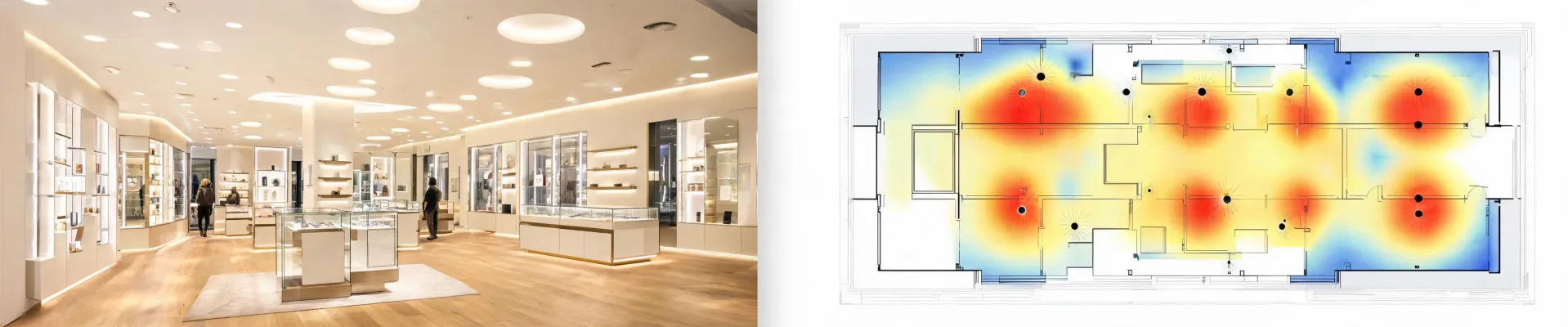
Here's what happened with that March batch. The factory had sourced their LEDs from a different bin than the initial samples. Same nominal specs, but the practical result was a visible shift across units. On a 2,000-square-foot retail floor with 60 of these downlights in a grid pattern, the eye picks up the variation immediately.
We rejected the whole batch. The factory pushed back—their own QC had passed it. But our contract, which I'd updated after a similar issue in 2023, specified a color temperature tolerance of ±150K against the agreed reference. These were hitting +350K. They redid the batch at their cost, but the delay pushed our project handover back three weeks. That delay cost our client roughly $18,000 in extended rental and labor costs, which they passed on to us as a contractual penalty.
That one hurt.
Where Opple fits into this
I'm not going to pretend Opple is the only brand getting this right. But I will say this: when we started using Opple's commercial lighting range as our color and spec benchmark during vendor evaluations, our reject rate dropped from about 9% to under 3% over the next two quarters.
Why? Because Opple's catalog documentation is unusually specific. They don't just say 'warm white' and leave it there. The downlight catalog pages spell out CCT, CRI, beam angle, and tolerance ranges per SKU. When you're negotiating with an OEM factory and you can point to a published, verifiable spec from an established brand, it changes the conversation. You're no longer arguing about what 'should' be acceptable—you're comparing against a standard that already exists.
That said, Opple isn't necessarily the right solution for every order. If you're a recessed lighting distributor serving the budget residential market, their pricing may not work for you. And if you need a truly custom form factor, private label from a specialized factory probably makes more sense than trying to force an existing product into your application.
The decision that kept me up at night
After the March rejection, I went back and forth between two paths for nearly a month. Path A: stay with our OEM factory, but invest in a stricter incoming QC protocol—pull every fifth unit, measure CCT, CRI, and lumen output before accepting. Path B: shift 60% of our downlight volume to a private label arrangement with a different factory, giving us full spec control but at higher per-unit cost.
On paper, Path B looked cleaner. Better control, clearer accountability. But it also meant walking away from a factory relationship that had otherwise been solid, and absorbing roughly 18% higher unit costs on our highest-volume product line.
I eventually went with a hybrid. We kept the OEM factory for standard products but moved our premium line—the spec-critical jobs—to private label. And we implemented the QC protocol from Path A on everything.
The upside of the hybrid was flexibility. The risk was managing two supply chains instead of one. I'm still not sure it was the right call, but it's worked for the last 14 months (as of early 2025, at least).
What I'd tell anyone sourcing downlights right now
Three things I've learned the hard way:
- Get the spec in writing before you get the quote. Not what the factory 'can do,' but what they will commit to per batch. And include a third-party testing clause. If they won't sign it, that tells you something.
- Use published brand specs as your reference point. Whether it's Opple or another established name, having a catalog spec to point to removes the ambiguity. It's not about copying—it's about setting a baseline everyone can agree on.
- OEM vs private label isn't a one-time decision. It's per-product, per-market, per-client. What works for your opple ceiling light replacement business may not work for your architectural downlight projects.
We still use Opple commercial lighting products as our internal reference for spec comparison. Not because they're always the answer, but because they're consistent. And in commercial lighting, consistency is the product.
Prices and specifications referenced in this article are based on internal sourcing records from Q1 2024 through Q1 2025. Verify current product specifications directly with manufacturers or authorized distributors.

Adrian Flores
Adrian Flores is an architectural and decorative lighting analyst specializing in pendant lights, chandeliers, wall lights, floor lamps, table lamps, and track lighting. He applies IEC 60598-1 luminaire requirements and photometric data to examine beam angle, shielding, surface temperature, mounting geometry, dimming compatibility, and glare. He writes practical guides for designers and buyers balancing visual character with usable illumination, safe installation, maintenance access, and total project cost.