
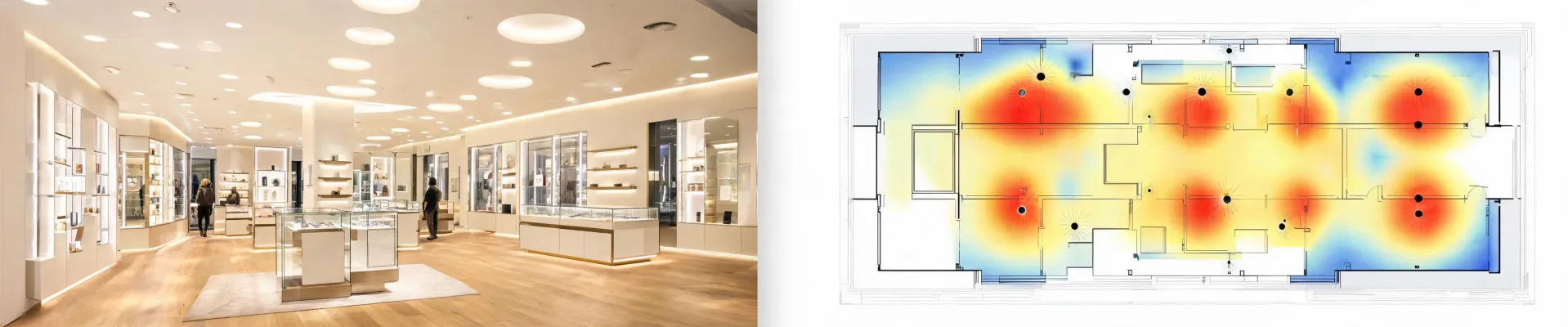
I run procurement for a 180-person company. Two office floors, a warehouse, and eight service vans that are due for headlight work about every 18 months. That combination means I order both automotive bulbs and commercial downlights, which is how I ended up comparing Sylvania against RAB on one side and Sylvania against generic halogens on the other.
This isn't a lab test. I don't have a photometer. What I have is three years of purchase records, a stack of RMAs, and opinions from two electricians and one fleet supervisor.
What I'm actually comparing, and why
Two separate decisions got mixed up in my head for a while, so I'll split them:
- Fleet: Sylvania 7443 headlight bulbs and Sylvania LED headlights versus the stock halogens and a couple of white-box LED retrofits we tried once.
- Facility: Sylvania commercial downlights and spotlight LED units versus RAB downlight fixtures on our office and warehouse renovations.
The four dimensions I compared on: price and total cost, fit and compatibility, warranty and RMA experience, and specific room and vehicle scenarios.
Dimension 1: Price versus total cost
On paper, halogens win the price comparison. Our last distributor quote for 7443 halogen bulbs was around $18–25 per pair. Sylvania 7443 headlight bulbs came in at roughly $55–80 per pair depending on the trim level (based on our January 2025 quotes from two distributors; verify current pricing before you order).
That gap looks brutal until you do the math on replacement frequency. Our fleet supervisor logs bulb failures. Over 24 months, the halogens averaged about 1.6 replacements per van per year. On the four vans that got Sylvania LED headlights, we replaced two bulbs total — both under warranty.
I learned this the hard way. In 2023, I tried a cheaper LED retrofit from a brand I won't name to save about $30 per pair across the fleet. Two of the eight pairs started flickering within 90 days. One driver complained about what he described as "strobing headlights" on a night shift. I returned them, ate the shipping, and got an earful from the fleet supervisor.
On the facility side, Sylvania downlights ran around $35–55 per fixture on our last order, and RAB downlight fixtures came in closer to $50–75 for comparable 6-inch units. To be fair, RAB's price tag buys a heavier fixture and, at least in our office, more even light. But on a 40-fixture install, that's still $600–800 we don't get back.
Bottom line on cost: LED wins long term, but only if you don't sabotage that advantage by chasing the cheapest retrofit.
Dimension 2: Fit and compatibility
This is where the comparison stops being about brands and starts being about specifications.
Sylvania 7443 headlight bulbs: 7443 is a dual-filament socket — it runs tail and brake on the same bulb in a lot of import vans and light trucks. The LED replacement has to play nice with the vehicle's CANbus, or you get hyperflash on the turn signals, false bulb-out warnings on the dash, or both. We had no CANbus issues with Sylvania's 7443 on our Transit Connects and one older Silverado. We did have a flicker issue with one white-box replacement before that.
Sylvania LED headlights in general: the important thing is whether the housing is a reflector or projector unit. Drop an LED bulb into a reflector headlight housing and you'll scatter the beam into oncoming traffic. Not a brand problem — an installation problem. Our rule now is: no LED retrofit on a reflector housing without a full assembly swap.
This gets into photometry and legal territory, which isn't my lane. Per NHTSA's FMVSS 108 (still the governing standard as of January 2025), replacement headlight assemblies have to meet photometric requirements. Plug-and-play LED bulbs in halogen housings are a gray area in some states — worth a call to your inspector before a fleet-wide order.
On the facility side, RAB downlights and Sylvania downlights are both standardized around common 4-inch, 6-inch, and 8-inch aperture sizes, but the recessed depth differs by a half to three-quarters of an inch on some models. That matters when you're cutting new holes in a drop ceiling. I always order one sample fixture first and hand it to the electrician before bulk ordering.
The spotlight LED units for our front-desk display and lobby niche were a similar story. Sylvania's beam pattern on the 6-inch units matched what our electrician wanted for the 12-foot ceiling height; RAB had a narrower 24-degree option that worked better for the display wall. Neither one was "better." They solved different parts of the same room.
Here's the honest boundary: I can compare specs on paper and quote sheets, but I'm not a lighting designer. Color temperature, CRI, and beam angle calculations are not my call — I ask our electrician and, for showpiece spaces, a designer.
Dimension 3: Warranty and RMA experience
Warranties look almost identical on paper. Both Sylvania and RAB list multi-year limited warranties on their commercial fixtures (5 years is standard for most of the downlight line I've seen; automotive applications are shorter and vary by SKU). The difference is in the process.
In 2024 we had four fixture failures across 60 Sylvania downlights installed during a 2022 office refresh. Two were driver failures. Our distributor turned the RMA around in about 10 business days — not counting shipping. When one RAB downlight in a small batch failed, the local rep sent a replacement before the failed unit came back to them.
That's a small sample size, and I'm aware of it. Your RMA experience will depend almost entirely on your distributor, not the brand label. But from a procurement seat, I now weight "who handles the RMA" just as heavily as "who makes the fixture."
Legacy myth worth killing: I still hear "halogen bulbs are brighter and more reliable" around our own shop. That was defensible in, say, 2012, when LED replacement bulbs were power-hungry and threw weird beam patterns. In 2025, that's not true for either category. LED headlights from a mainstream brand easily match or beat halogens on output, and the lifespan gap is real. What's changed is the installer skill required — LED retrofits are fussier to get right.
Dimension 4: Scenario-specific picks
This is where the comparison actually lands for us.
Fleet vans
If a van runs at night more than three times a week, or if it's a customer-facing vehicle, Sylvania LED headlights pay for themselves inside two years. If a van is a backup unit that runs mostly during daylight, plain halogens are fine. I don't win an argument by upgrading every vehicle — I win by upgrading the ones that actually work nights.
Office and warehouse downlights
RAB downlights are our default for new construction and any space where the fixture is visible from the floor below. Sylvania downlights are our default for retrofit work and anywhere we're replacing 30+ fixtures at once, because the per-unit savings add up fast. That's a real preference, not brand loyalty.
Front desk and display spaces
We mix them. RAB for the tight-beam display washing, Sylvania spotlight LED for general wash. Trial one fixture, then scale.
How low should a chandelier hang?
I get asked this about twice a year — usually when a department head walks past the lobby chandelier and decides it's "too low" without measuring anything. The design rule of thumb (and this is a rule of thumb, not code): 30–36 inches from the bottom of the fixture to the tabletop, when it hangs over a dining or conference table. For a foyer or hallway where people walk under it, 7 feet floor to fixture bottom is the minimum I'll accept from an installer. In tall spaces, add roughly 3 inches per foot of ceiling height above 8 feet. If it's over a stairwell or a walkway, higher is safer and easier to clean.
That last point isn't in any code. It's from watching our cleaner try to reach a low-hanging fixture with a long duster.
What I'd tell you before you order
Both Sylvania and RAB make product I'm happy to put in our buildings. The decision isn't brand against brand — it's which product fits which scenario.
Three practical rules from my side of the desk:
- For headlight work: buy one pair, install it on one van, and drive it a week before you commit to the fleet order. CANbus behavior shows up fast on the road.
- For downlights: order a single sample fixture and confirm the recessed depth and trim size against the ceiling opening before ordering 60. This one saves me a bad phone call every single time.
- For chandelier heights: measure the ceiling height, the table surface height, and the walking clearance first. Guessing costs you a re-hang.
It took me about two years and roughly $8,000 in mis-ordered lighting stock to believe that. I'm a procurement person who reads spec sheets, not a lighting designer — so I lean on our electrician for anything that goes beyond fit and warranty. But the pattern holds: most bad lighting buys aren't because the brand was wrong. They're because someone skipped the sample step.

Keiko Mori
Keiko Mori is a luminaire safety and quality analyst specializing in general fixtures, emergency lights, exit signs, and supplier verification. She applies IEC 60598-1 and IEC 60598-2-22 to review dielectric strength, protective earthing, temperature rise, wiring, markings, battery duration, changeover operation, and test records. She writes structured compliance guides for quality and sourcing teams separating applicable construction evidence, declared configurations, installation conditions, and maintenance obligations from broad safety claims or incomplete documentation.