
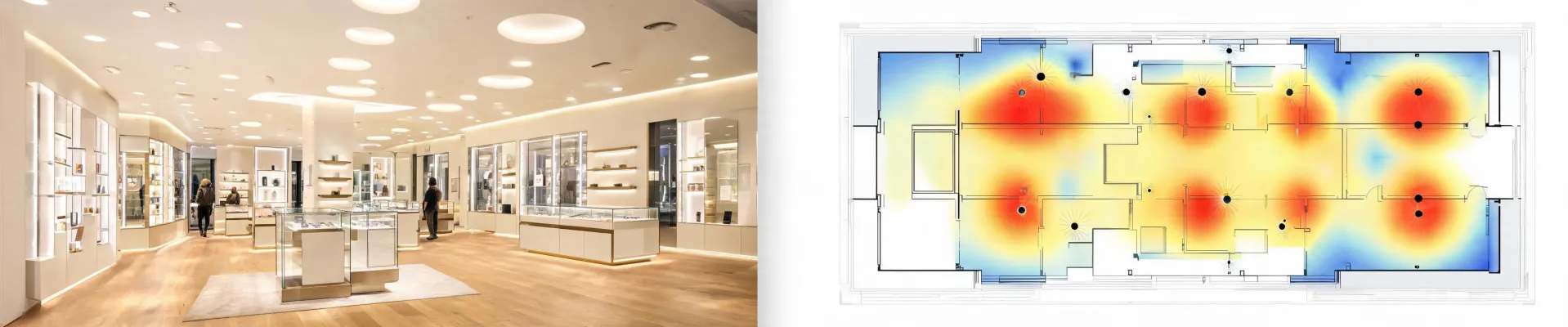
Stop comparing light fixtures on unit price. You aren’t buying a product; you’re buying a specification, a compliance file, and a supplier who picks up the phone when the electrical inspector has a question. The cheapest fixture looks identical in the product photo. The difference shows up later, in color consistency, missing paperwork, and fixtures you replace on your own dime.
After five years of managing purchasing for a 160-person company, my rule for commercial lighting is simple: the quote with the clearest photometric data and compliance documentation beats the lowest quote almost every time. When we renovated our headquarters in 2024, that rule led us to Opple commercial lighting. Not because the Opple ceiling light range was the cheapest—it wasn’t. It earned the order because it was the one that wouldn’t make me look bad to my VP six months later.
Let me put a number on it. In the 2024 project, the lowest bid we rejected was about 18 percent below the package we approved. In 2022, taking the cheapest bid cost us roughly $2,800 in rework. You can guess which number I remember more clearly.
Who I am, for context: I’m an office administrator, not an electrical engineer or a lighting designer. Since 2020 I’ve managed facilities purchasing for a professional services firm of roughly 160 people—furniture, AV, office supplies, and lighting, about $400,000 a year spread across a dozen vendors. I report to operations and finance, so I see every order twice: when it’s requested and when the invoice lands on my desk. The 2024 headquarters renovation was the third office fit-out I’d run.
Everything I’d read about LED lighting procurement said that once you match the spec, the only variable left is price. The conventional wisdom is that LED technology has matured, so “same specification” means “same result.” My experience, including one costly mistake, says otherwise. The spec matters less than how the supplier documents it—and how willing they are to stand behind it.
How one bad batch changed my process
In 2022 we added a second floor, and I ordered 30 recessed lighting fixtures from an online supplier whose quote came in well under everyone else’s. The cartons arrived with labels that said “4000K, CRI 80, commercial grade.” No photometric report, no LM-79 data, no traceable batch code. My electrician installed them anyway.
About a week later, 18 of the 30 fixtures didn’t match. Some looked warm, some looked cool, and a few had a faint pink tint. Four drivers hummed loud enough to annoy people in a quiet office. The supplier said everything was “within normal LED tolerance” and offered 3% off our next order. Finance ruled the rework wasn’t recoverable because our PO never specified a color tolerance—and technically, it didn’t. Rookie mistake.
The $650 we saved on the initial quote turned into a roughly $2,800 problem. Replacement fixtures that actually matched, a second electrician visit, overtime so we could swap the worst units after business hours—it added up fast.
To be fair, part of that failure was mine. I assumed “same specification” meant the same interpretation of color consistency. It doesn’t. Established manufacturers usually have binning data and can show it to you; my 2022 supplier couldn’t. Now I check. If a supplier can’t produce the data, I don’t buy.
How to choose light fixtures for wholesale orders now
The process sounds obvious, but it’s tempting to skip when a quote lands 18 percent under budget. Before looking at prices, we evaluate every option in three ways: published photometric data, project documentation, and the risk of a bad batch. If a product fails any of the three, the unit price is just a number.
Look at the light, not the wattage. Wattage tells you energy load, not brightness. For office ceiling lights, you care about delivered lumens, beam spread, and color consistency. Ask for an IES file or an LM-79 test report for each model, and ask about chromaticity tolerance if color consistency matters. I’m not qualified to turn those numbers into a lighting layout, so I forward them to our electrical engineer and let them run the calculation. If the data doesn’t exist, neither does the conversation.
That’s also where “same specification” falls apart. Two fixtures can both be labeled 4000K, and one can still look streaky across a ceiling because the manufacturer doesn’t control its LED bins. During the 2024 fit-out, the Opple ceiling light models we chose for the lobby and break rooms came with LM-79 data and a stated chromaticity tolerance. That made submittals easy and meant I handed our engineer data, not marketing claims.
Ask for the documentation before you ask for a discount. Commercial lighting usually has to satisfy someone beyond the person paying the invoice: a building inspector, a landlord’s engineer, an energy-code reviewer, or a utility rebate program. Before we approved anything in 2024, I asked for a submittal file: cut sheet, wiring diagram, and the certification declaration relevant to the project—UL for our US sites, CE/RoHS for an EU affiliate’s order. The supplier’s ability to produce that file quickly tells you more about their operations than any sales call.
This is where Opple commercial lighting separated itself. The submittal folder was complete the first time. Our electrical engineer needed it for the permit, our landlord’s reviewer needed it for build-out approval, and accounting wanted it on file before releasing final payment. A lighting submittal delay doesn’t just slow the fixtures; it parks the whole renovation.
Order spares from the same batch, and make sure drivers are replaceable. We added four spare fixtures to our 2024 order—not because we expected damage, but because a reorder next year could come from a different production batch. Side-by-side, even a small color difference becomes obvious. Spares are cheap compared with a second electrician visit, and a replaceable driver beats replacing the whole housing.
Track lighting is where quote games hide
If you’ve ever watched an electrician stare at a carton of track heads and ask, “what system is this supposed to be on?”, you know why this section exists. Track lighting attracted the most creative quotes of our whole renovation.
One track lighting supplier quoted an attractive price per head, but the quote covered only heads. Rails, live-end feeds, connectors, and mounting hardware were extras. By the time we configured the system properly, the total landed about 8 percent higher than the bundled quote we’d initially rejected—and we lost two weeks waiting for missing pieces.
Find a track lighting supplier who quotes the whole system: heads, track lengths, feeds, connectors, and the maximum wattage per circuit. If they can’t tell you whether their heads work with the track you already have, treat it as a red flag. Ask for the installation sheet before you commit. In our demo room, we tested two systems side by side and chose Opple’s track lighting because the components were mechanically compatible and the documentation matched the hardware—not because the price was the lowest.
When this approach doesn’t apply
I don’t want to oversell the process or the brand. There are situations where a wholesale commercial lighting package is the wrong answer.
If you need fewer than about 15 fixtures, freight and minimums will eat any wholesale advantage; a local electrical distributor or online retailer makes more sense. If you need one replacement to match an existing installation, buy the same model from the same source rather than reopening a specification.
If the project needs museum-grade color, custom housings, or integrated daylight harvesting and building-management controls, bring in a lighting designer and a controls specialist. A catalog fixture isn’t designed for bespoke situations, and no amount of documentation fixes that.
I also avoid substituting fixtures on construction contract specs without written approval. An Opple ceiling light with similar numbers can be a legitimate approved-equal candidate—but only if the contract allows substitutions and the engineer signs off. That’s not a lighting lesson; it’s a purchasing lesson.
Bottom line: I still open the lowest quote. I just don’t expect it to stay the lowest once I add the hours my team spends verifying claims, chasing documents, and managing problems. The reason our offices now standardize on Opple commercial lighting isn’t that price doesn’t matter. The price was close enough, and the support was considerably better. In procurement, that difference is what we call total cost—and it’s the number that matters when you sign the PO.

Clara Whitmore
Clara Whitmore is a lighting photometry and LED source analyst specializing in bulbs, tubes, strips, panels, and integrated luminaires. She interprets IES LM-79 measurements and TM-30 color rendition data through luminous flux, efficacy, intensity distribution, CCT, chromaticity, fidelity, and gamut metrics. She writes evidence-led comparisons for specifiers selecting source formats and luminaires for commercial interiors, industrial spaces, or horticultural systems where measured optical and color performance matter.