
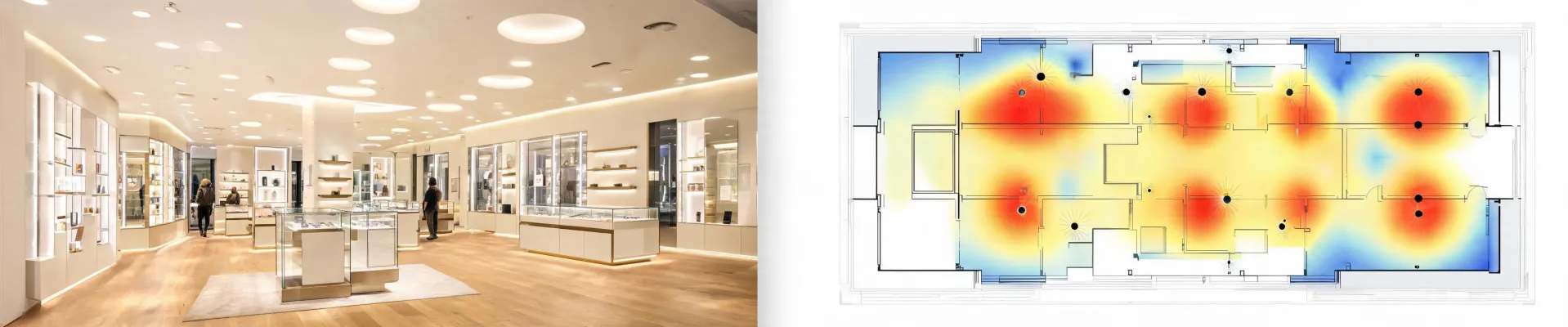
March 2024. We were six weeks out from a hotel group's flagship reopening — a six-floor gut renovation that needed 1,440 bulk recessed lighting units and roughly 420 ceiling lights. Opening night was booked. Every agency, every VIP, every press slot was locked.
I handle quality and brand compliance for our lighting sourcing. That means I don't design the circuits — that's our electrical team's call — but I sign off on every batch before it goes to a site. If it ships wrong, my name is on the approval sheet.
We sent an RFQ to six manufacturers. Quotes ranged from $11.40 to $17.80 per unit for the same spec sheet. On a run this size, that spread is worth roughly $9,000 depending on who you pick. Here's what actually happened when we picked.
The quote that looked "obviously" best
The cheapest bid came in at $11.40, lead time described as "approximately 40 days, to be confirmed." The next one up — a factory in Ningbo, $16.20 per unit — quoted 42 days with a penalty clause attached.
The gap was about $6,900 on the whole order. On a project north of $340,000, it sounds like rounding. But I own a budget line, so I asked the cheap supplier two questions: "What is your in-house SMT capacity per shift?" and "Which LED chip bin do you commit to for 4000K?"
First answer: vague. Second answer: "Whatever is available that week is within industry standard."
That second answer should have ended the conversation. It didn't — I kept them on the shortlist because the price was genuinely good and I thought I could pin down specs in the PO. I've since stopped doing that.
The sample that passed — until we measured it
The cheap supplier sent us five production samples. Out of the box, they looked clean. Smooth diffuser, tight bezel, labeled "4000K / 90 CRI" on the back.
We ran them through our spectrophotometer. Three read 3950–4020K — fine. One hit 3,410K. One hit 4,660K. That's a 1,250K spread inside a single five-piece sample set.
For a hotel corridor, that's fatal. Walk down the hall at night and you'll see a different color temperature glowing under every third door. It doesn't matter that the average is 4,000K. What matters is consistency, and the batch had none.
When I sent the readings, the vendor's engineering contact wrote back: "Within industry standard." They are technically correct that some datasheets list wide bins. But for a commercial lighting private label project where our name is on the box, "within industry standard" is not the standard we can sell.
I rejected the batch. They agreed to redo it, then tried to move the change-order cost back onto us.
The turnaround I didn't see coming
Around the same week, the Ningbo factory called. Not an email — a call, which in my experience is a signal in itself. Their production lead said one of the LED chip batches we'd specified had come in slightly off. They had a substitute chip from a second supplier that would land in spec, but it would add $0.40 per unit.
My first instinct was to push back. $0.40 × 1,440 downlights — that's a $576 ask on a project where I was already being watched on cost.
Our QC lead pushed back on me instead. Requalifying a new chip means another test run, redone energy compliance paperwork, and at least five working days before the first carton ships. Five days, sitting between us and an opening night that was already sold.
We approved the $0.40.
Here's the part I want to be honest about: I don't have hard data on how often that particular substitution fails in the field. I'm not a semiconductors engineer — I can't speak to the chip-level reliability of either bin. What I can tell you from a compliance and brand perspective is that the delayed requalification was the bigger risk, and we paid $576 to make it disappear.
That turned out to be the cheapest decision we made on the whole project.
Delivery day — and what saved us
The container landed May 2. We pulled a 5% sample — 72 downlights across the pallet — and every one measured inside a ±200K tolerance band around 4,000K. Tight enough that when the corridors were lit two days later, the whole floor read as one warm-white wash.
Installation started May 3. No returns. No re-lighting. Opening happened on schedule.
What actually made the difference wasn't heroic — it was boring:
- We asked how the lead time was built, not just what it was. "About 40 days" and "42 days with a penalty if we miss" are not the same product.
- We tested per-unit consistency, not just average color temperature. Average hides variance, and variance is what customers see.
- We pre-negotiated change-order pricing in the original contract. When the chip substitution came up, there was no leverage fight — just a number and a yes or no.
- When the price gap was under 5% of total project value, we paid for the commitment. The $6,900 we didn't save looks small next to what a delayed reopening would have cost.
Where Opple fits into this
Opple commercial lighting and Opple ceiling light lines come up often when we're benchmarking suppliers for bulk recessed lighting runs — partly because their range covers the mid-to-high commercial tier we usually spec into, and partly because they support OEM and private label work directly. That said, the brand on the box is a starting point, not a decision. I evaluate Opple the same way I evaluate any other factory: color consistency across the batch, documented bin commitments, and whether they'll put their delivery promise in writing.
Anyone asking how to evaluate ceiling light manufacturers usually gets a spec-sheet answer. My answer is less tidy: trust the factory that answers the uncomfortable questions honestly, and treat "approximately" as a red flag word in any lead time.
To be fair, the cheapest vendor might have delivered fine — plenty of projects go through that way and nobody writes about them. But I can't sell "might have" to a hotel group on opening night.
Bottom line, if you're sourcing bulk recessed lighting or a private label ceiling light line: price matters, but spec consistency and delivery certainty are the two things that will actually wreck your timeline if you get them wrong. Budget for the 5% premium when the project can't slip. Take it from someone who got the call three weeks before the deadline and had to make the decision — the certainty was 100% worth the extra dollars per unit.

Clara Whitmore
Clara Whitmore is a lighting photometry and LED source analyst specializing in bulbs, tubes, strips, panels, and integrated luminaires. She interprets IES LM-79 measurements and TM-30 color rendition data through luminous flux, efficacy, intensity distribution, CCT, chromaticity, fidelity, and gamut metrics. She writes evidence-led comparisons for specifiers selecting source formats and luminaires for commercial interiors, industrial spaces, or horticultural systems where measured optical and color performance matter.