
-
Who This Checklist Is For
-
The 7-Point Spec Checklist
-
1. Start with the space and the job
-
2. Calculate lumens, not wattage
-
3. Set colour temperature and CRI before sampling
-
4. Verify certifications before you trust the spec sheet
-
5. Check the mechanical details — dimensions, driver, dimming
-
6. Get a pre-production sample and test it hard
-
7. Lock the lead time, delivery terms, and penalties
-
1. Start with the space and the job
-
Common Mistakes That Wreck Bulk Ceiling Light Orders
If you're buying commercial ceiling lights at volume, you probably don't need another “why LED is great” article. You need a checklist so that the fixtures arrive on spec — ideally before the opening date. I'm a spec specialist at Opple, a commercial lighting and spotlight manufacturer. Over the last eight years, I've helped process 200+ rush orders for bulk commercial lighting, including 48-hour turnarounds for clients with a hard deadline. This checklist is what we run through when a client is ordering Opple ceiling lights at volume.
Use this when you need to order commercial ceiling lights in bulk — for an office, retail space, hotel, or warehouse. It's designed for time-sensitive projects, but it'll also cut waste on longer timelines.
Who This Checklist Is For
If you're on the dealer, distributor, or contractor side and you're responsible for specifying bulk commercial ceiling lights, this is for you. It assumes you already know how LEDs work, and you don't need an intro to color temperature. Instead, you need to avoid the mismatches that turn a routine order into a crisis.
The 7-Point Spec Checklist
1. Start with the space and the job
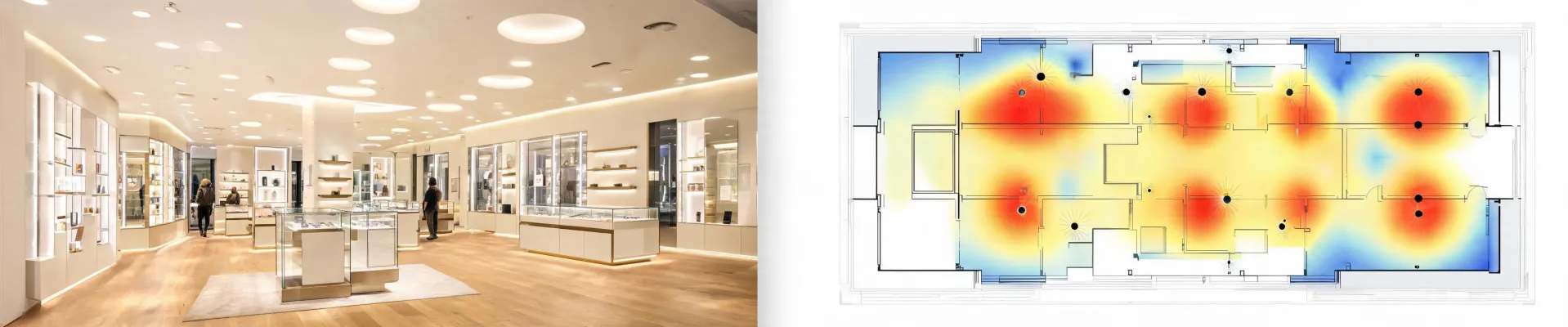
Before fixture shopping, define the room dimensions, ceiling height, surface colors, and the visual task. You also need a target illuminance: an open office usually wants 300 lux, retail displays often run 500–750 lux, and corridors can get away with 100 lux. Most buyers overlook this because it feels like basic design work, but it determines how many fixtures you actually need.
One client called with a warehouse “similar to the showroom” and ordered 300 high-bays. The showroom had a white ceiling and 6m height; the warehouse had dark racking and 8m height. They needed more than double. We caught it in the spec review, but it's a classic blind spot.
2. Calculate lumens, not wattage
This is the biggest misconception in commercial lighting. Wattage is an input; lumens is the output. When you compare fixtures, compare system lumens and lumens per watt. For a 200 m² office at 300 lux, you need around 60,000 delivered lumens. With a 120 lm/W panel, that's about 500W of installed power; with a 90 lm/W panel, it's 667W. That difference changes both your fixture count and your energy cost.
3. Set colour temperature and CRI before sampling
This might be the most underrated spec decision: decide CCT and CRI up front. 4000K is the workhorse for offices and retail; 3000K suits hotels and restaurants; 5000K leans industrial. For CRI, 80 is the minimum for general commercial; 90+ matters for fabrics, paint, or food displays. And don't skip the MacAdam ellipse — a 3-step ellipse gives consistent colour across fixtures, which matters when you install a long row of ceiling panels. Most people only ask about CCT, then wonder why fixtures look different side by side.
4. Verify certifications before you trust the spec sheet
For North American projects, check UL or ETL listing; for energy rebate eligibility, DLC qualification is key. In Europe, look for CE and ENEC. Per FTC guidelines (ftc.gov), green claims like “recyclable” must be substantiated — so if a supplier claims a certification or environmental attribute, ask for the certificate, not a marketing line.
I once had a supplier show a “UL Listed” driver, but the fixture housing wasn't part of the listing. When the inspector flagged it, the whole order stalled. That's why we verify listings by name before committing.
5. Check the mechanical details — dimensions, driver, dimming
This is the step that gets ignored until somebody tries to install 200 fixtures. Confirm the cutout size, overall dimensions, mounting type, and whether the driver is removable. Also ask about driver specifications: power factor, THD, and dimming compatibility (0-10V, DALI, TRIAC). A 19% THD can interfere with building systems; we routinely supply fixtures with THD under 10% for commercial projects.
We had a client order recessed panels from a budget vendor, and the driver added 1.5 inches that didn't fit their ceiling void. That's a costly discovery on site. Ask for mechanical drawings, not just product photos.
6. Get a pre-production sample and test it hard
If time allows, request a sample and run it for 24 hours. Measure actual wattage, check the light distribution, and look for colour shift between samples. If you're comparing vendors, ask each for an IES file and photometric report. A sample can look great in a showroom but fail to deliver the expected uniformity in real room geometry.
During one rush order, the sample from a low-cost vendor looked perfect, but the THD reading was 19% — double the building limit. We switched suppliers and added a rush shipping fee on top of the order. That experience taught me to trust the spec sheet, not just the visual appearance.
7. Lock the lead time, delivery terms, and penalties
A reliable supplier should state their production schedule, shipping time, and what happens if the date slips. For urgent orders, ask if they have a rush service and what the incremental cost is. We've paid $800 extra for a two-day shipping upgrade to save a $12,000 project — not fun, but better than the alternative. Also confirm how transit damage claims are handled so you're not left with pallets of broken fixtures.
Common Mistakes That Wreck Bulk Ceiling Light Orders
Even with the checklist, these mistakes show up again and again:
- Comparing only unit price. The true cost includes freight, customs, storage, and installation. A cheap fixture can become expensive when you add rework.
- Assuming “same specs” across vendors. One supplier's “4000K” can look noticeably different from another's. And lumen output often is tested at 25°C; in a hot ceiling cavity, it drops. Ask for the test conditions.
- Ignoring emergency lighting and code items. For bulk ceiling light orders, it's easy to forget battery backup or exit-rated fixtures. Check the local code before the order is placed.
- Trusting a “one-stop shop” that isn't. At Opple, we're clear about where we excel: commercial LED ceiling fixtures at scale. If a project needs a custom IoT building automation layer, that's not our core play, and we'll tell you so — and point you toward integration specialists. A vendor who admits their boundaries is more reliable than one who promises everything.
That's the guide. Run through these seven points before you send a PO, and you'll avoid the most expensive lesson in commercial lighting procurement: “it looked fine in the sample.”

Clara Whitmore
Clara Whitmore is a lighting photometry and LED source analyst specializing in bulbs, tubes, strips, panels, and integrated luminaires. She interprets IES LM-79 measurements and TM-30 color rendition data through luminous flux, efficacy, intensity distribution, CCT, chromaticity, fidelity, and gamut metrics. She writes evidence-led comparisons for specifiers selecting source formats and luminaires for commercial interiors, industrial spaces, or horticultural systems where measured optical and color performance matter.